You’re texting someone, sharing a thought, maybe even opening up a little… and the reply comes back as just “hm.”
No emoji. No explanation. Just two letters.
Instant confusion, right?
You start wondering: Are they bored? Thinking? Annoyed? Or just busy?
This tiny response can feel surprisingly powerful, especially in a world where texts carry emotions without tone or facial cues.
The hm meaning in text isn’t fixed or universal. That’s what makes it interesting — and tricky. Depending on context, mood, and relationship, it can mean curiosity, hesitation, indifference, or deep thought.
In modern digital conversations, understanding small expressions like “hm” actually matters more than we think. These micro-responses shape how we interpret interest, respect, and emotional availability.
What Does HM Meaning in Text?
At its core, “hm” is a thinking sound turned into text.
It usually signals that the person is:
- Pausing to think
- Unsure how to respond
- Processing information
- Mildly interested but not fully engaged
Unlike clear words like yes or no, hm is intentionally vague. That’s why it often creates confusion.
Real-Life Examples
- You suggest a plan:
“Let’s meet tomorrow?”
Reply: “Hm.”
→ They’re thinking, not convinced yet. - You share an opinion:
“I think that movie was overrated.”
Reply: “Hm.”
→ They’re considering your point. - You vent emotionally:
Reply: “Hm…”
→ They might not know what to say.
In short, hm means “I’m processing this”, not necessarily agreement or rejection.
Origin and Background of the Term
Long before texting existed, humans made sounds like hmm, uh, and eh while thinking. These sounds are called non-lexical utterances — vocal expressions that carry meaning without being full words.
When texting became common, people naturally brought these sounds into writing.
Over time:
- “hmm” became thoughtful or curious
- “hm” became shorter, quicker, and more neutral
The shorter version fits modern communication perfectly. Fast. Minimal. Emotionally ambiguous.
Interestingly, linguists note that hm appears in many languages, not just English. That tells us it’s deeply human — a natural thinking response, now digitized.
How HM Is Used in Daily Life
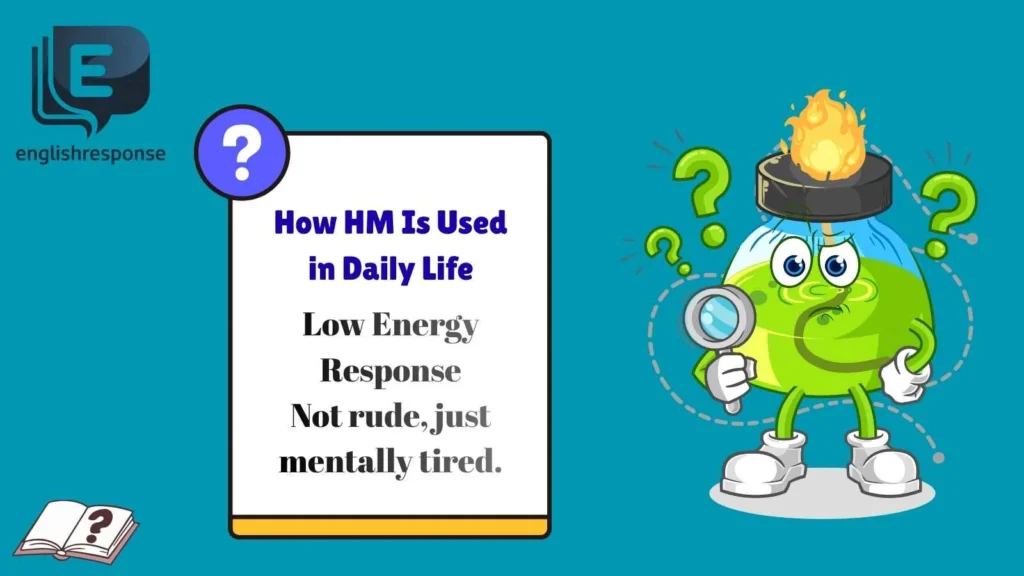
You’ll see hm everywhere once you notice it. Here are some common daily-life uses.
- Thinking Mode
When someone needs time before responding. - Polite Acknowledgment
They’ve read your message but aren’t ready to reply fully. - Uncertainty
They’re unsure how they feel about what you said. - Low Energy Response
Not rude, just mentally tired. - Soft Disagreement
They don’t agree, but don’t want conflict. - Conversation Placeholder
Keeping the chat alive without commitment.
It’s small, but context gives it weight.
Emotional or Practical Meaning of HM
Emotionally, hm can feel heavy, especially in close relationships.
Why?
Because humans crave clarity.
When someone replies with hm, it can trigger:
- Overthinking
- Self-doubt
- Emotional distance
Practically, though, it’s often harmless.
In modern culture, where multitasking is constant, hm can simply mean “I’m here, just thinking.”
The emotional impact depends less on the word itself and more on:
- Who sent it
- When they sent it
- What came before
Understanding this can save a lot of unnecessary stress.
Similar or Related Terms
Here are terms people often confuse with hm, and how they differ:
- Hmm – More thoughtful or curious
- Oh – Realization or mild surprise
- K – Detached or dismissive
- Okay… – Hesitation or doubt
- Uh – Confusion or uncertainty
- … – Silence, often emotionally loaded
Each carries a slightly different emotional temperature.
Common Misunderstandings About HM
Let’s clear up some myths.
- “HM means they’re annoyed.”
→ Not always. Often, they’re just thinking. - “HM is rude.”
→ It’s neutral unless paired with context. - “HM means they don’t care.”
→ Silence shows disinterest more than hm does. - “HM ends the conversation.”
→ It can pause it, not end it. - “HM is passive-aggressive.”
→ Only if the relationship already has tension. - “HM has one fixed meaning.”
→ It doesn’t. Context is everything.
Examples of HM in Sentences
Here are everyday, natural examples:
- “Hm, I never thought about it that way.”
- “Hm… let me check my schedule.”
- “Hm, that’s interesting actually.”
- “Hm, I’m not sure yet.”
- “Hm. Can we talk later?”
- “Hm, give me a minute.”
- “Hm, I need to think.”
Notice how tone changes with added words or punctuation.
Why Understanding HM Meaning in Text Matters Today
Digital communication lacks tone, facial expression, and body language. That’s why tiny words carry big meaning.
Understanding hm helps you:
- Avoid unnecessary overthinking
- Read conversations more accurately
- Respond with emotional intelligence
- Communicate more clearly yourself
In dating, friendships, work chats, and family groups, misreading small cues can create big misunderstandings.
Knowing what hm really means puts you back in control of the conversation — and your emotions.
FAQs:
What does hm mean in simple words?
It means the person is thinking, unsure, or processing what you said.
Is hm positive or negative?
It’s neutral. The emotion depends on context and relationship.
Where is hm commonly used?
Mostly in text messages, chats, and social media conversations.
Is hm formal or informal?
It’s informal and best used in casual communication.
Why do people search for hm meaning in text?
Because it’s ambiguous, emotionally confusing, and very common in modern texting — especially in relationships.
Conclusion:
The hm meaning in text isn’t something to fear or overanalyze — it’s a reflection of how humans think, pause, and process in a fast digital world.
Sometimes it means curiosity.
Sometimes just a quiet moment between thoughts.
Understanding it gives you clarity, confidence, and emotional balance in conversations that matter.

Rana Sawalha is a passionate language enthusiast and author at EnglishResponse, dedicated to helping readers improve their English communication skills. With a focus on practical tips, engaging examples, and real-world conversation strategies, Rana Sawalha empowers learners to speak confidently and respond like a pro in any situation.