You’re texting someone, checking your phone, or trying to log into an app—and suddenly you see “OTP” pop up. Maybe it’s in a message from your bank. Maybe a friend casually drops it in a chat. For a moment, you pause and think, Wait… what does OTP mean in text?
You’re not alone.
In today’s fast-moving digital world, short forms and abbreviations shape how we communicate. Some save time. Others carry serious meaning. OTP is one of those terms that looks simple but actually plays a huge role in modern communication and online safety.
Understanding this term isn’t just about slang—it’s about protecting your accounts, avoiding scams, and staying digitally aware. And once you truly get it, you’ll notice how often it shows up in daily life.
What Does OTP Meaning in Text?
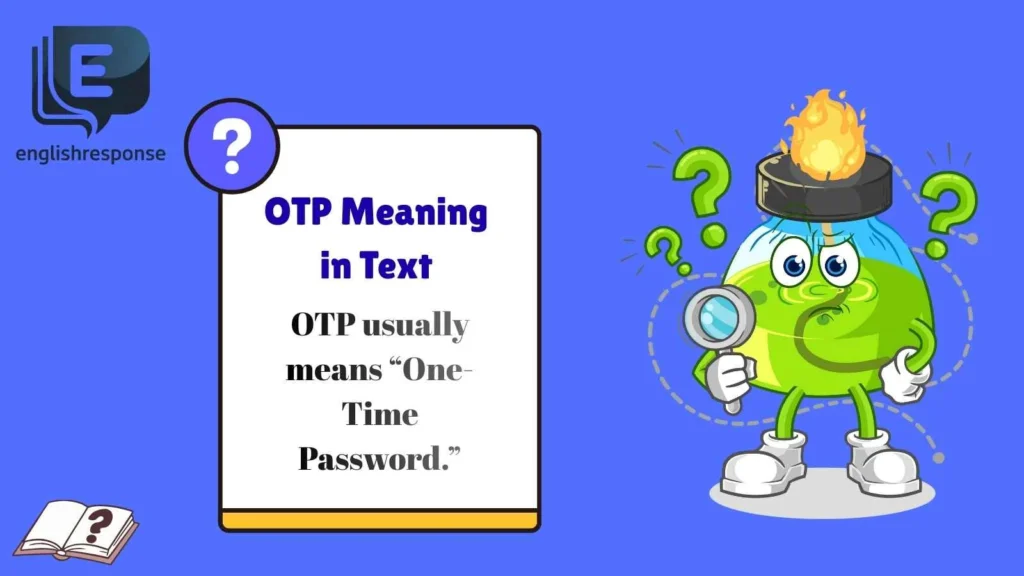
In text messages, OTP usually means “One-Time Password.”
Simply put, it’s a temporary code sent to you—usually via SMS, email, or an app—to verify that you are really you.
Think of it like this:
- Your password is your house key
- An OTP is a security guard who double-checks your identity
This code works only once and expires quickly. That’s why it’s called one-time.
Real-life examples:
- You try logging into your email → you get a message: “Your OTP is 482931”
- You’re paying online → the app asks for an OTP to confirm the transaction
- You reset a password → an OTP is sent to verify your identity
In texting and digital communication, OTP is all about security and trust.
Origin and Background of the Term
OTP didn’t start as internet slang or casual texting language. Its roots are deeply tied to cybersecurity and digital authentication.
Back in the early days of the internet, passwords alone weren’t enough. Hackers found ways to steal or guess them. Tech experts needed a second layer of protection—something temporary, dynamic, and hard to misuse.
That’s where OTP came in.
Banks were among the first to use it. Then email providers followed. Eventually, social media platforms, payment apps, and even gaming services adopted it.
Over time, the term “OTP” moved from technical documentation into everyday language. Today, even non-tech users casually say things like, “Wait, I’ll send you the OTP.”
What started as a security solution became a normal part of digital life.
How OTP Is Used in Daily Life
You probably interact with OTPs more than you realize. Here’s how they show up in everyday situations:
- Logging into accounts
After entering your password, you receive an OTP to confirm access. - Online payments
Banks send OTPs to prevent unauthorized transactions. - Password recovery
Forgot your password? An OTP helps you reset it safely. - App verification
New apps often send OTPs to verify your phone number. - Two-factor authentication (2FA)
OTPs act as the second layer of login security. - Sensitive changes
Updating your email, phone number, or security settings often requires an OTP.
In short, OTPs quietly work in the background to keep your digital life safe.
Emotional or Practical Meaning of OTP
At first glance, OTP seems purely technical. But emotionally and practically, it represents something deeper: trust.
When you receive an OTP, a system is saying, “We want to make sure it’s really you.” That matters.
In a world where data breaches and scams are common, OTPs provide peace of mind. They protect personal information. They give users a sense of control.
Culturally, OTPs have become a symbol of digital responsibility. Sharing your OTP is now widely known as dangerous—almost like giving someone your ATM PIN.
So yes, OTP is small. But its impact is huge.
Similar or Related Terms
Here are some related terms you might see alongside OTP:
- 2FA (Two-Factor Authentication)
Uses OTP plus a password for extra security - Verification Code
A general term; OTP is a specific type - Authentication Code
Confirms identity during login or actions - Security Code
Often used interchangeably, but broader - PIN
A fixed code, unlike a one-time OTP
Each term relates to identity verification, but OTP stands out because it’s temporary and unique.
Common Misunderstandings About OTP
Despite how common it is, OTP is often misunderstood. Let’s clear things up.
- “OTP is just a password”
No—it’s temporary and works only once. - “Sharing OTP is harmless”
Wrong. Sharing it can lead to account theft. - “OTPs don’t expire”
They usually expire within minutes. - “OTP is only for banks”
It’s used everywhere—apps, email, social media. - “OTP messages are always safe”
Scammers can fake messages. Always verify the source.
Understanding these points can save you from serious trouble.
Examples of OTP in Sentences
Here’s how OTP appears naturally in everyday conversations:
- “I can’t log in until I receive the OTP.”
- “Don’t share your OTP with anyone.”
- “The app sent me an OTP for verification.”
- “My bank asked for an OTP to confirm payment.”
- “I missed the OTP message, can you resend it?”
- “OTP expired, so I had to request a new one.”
- “They added OTP for extra security.”
- “Always check before entering an OTP.”
These examples show how normal and essential the term has become.
Why Understanding OTP Matters Today
We live in a hyper-connected digital age. From shopping to banking to socializing—everything happens online. And with convenience comes risk.
Understanding OTP helps you:
- Protect your personal data
- Avoid scams and fraud
- Navigate apps confidently
- Recognize suspicious activity
- Educate others, especially elders or kids
Knowledge is power. And knowing what OTP means—and how it works—makes you a smarter, safer digital citizen.
FAQs:
What does OTP meaning in text in simple words?
OTP means a one-time code sent to verify your identity, usually for security purposes.
Is OTP positive or negative?
It’s positive. OTP exists to protect users and prevent unauthorized access.
Where is OTP commonly used?
Banks, social media apps, email services, payment platforms, and websites.
Is OTP formal or informal?
The term is neutral—used in both professional and casual settings.
Why do people search for OTP meaning in text?
Because it appears frequently, and people want to stay informed and safe as digital usage grows over time.
Conclusion:
So now you know—OTP meaning in text isn’t just another abbreviation. It’s a guardian of your digital life, quietly working to keep your information secure.
Once you understand it, you stop ignoring those messages. You become more alert. More confident. More aware.
In a world where technology keeps evolving, knowledge like this isn’t optional—it’s empowering. Stay curious, stay informed, and never underestimate the power of understanding the small things. 🌱

Rana Sawalha is a passionate language enthusiast and author at EnglishResponse, dedicated to helping readers improve their English communication skills. With a focus on practical tips, engaging examples, and real-world conversation strategies, Rana Sawalha empowers learners to speak confidently and respond like a pro in any situation.