Have you ever received a text that simply said “IDTS” and found yourself staring at your screen wondering what it meant? You’re not alone.
In today’s fast-paced digital world, short forms and slang dominate conversations. From “LOL” to “BRB,” texting language evolves constantly. But IDTS meaning in text isn’t always obvious at first glance.
Understanding these abbreviations isn’t just about staying trendy. It’s about avoiding misunderstandings, responding appropriately, and staying connected in online conversations. A simple acronym can completely change the tone of a message.
In this guide, we’ll break down what IDTS really means, where it came from, how people use it in daily life, and why it matters more than you might think.
What Does IDTS Mean?
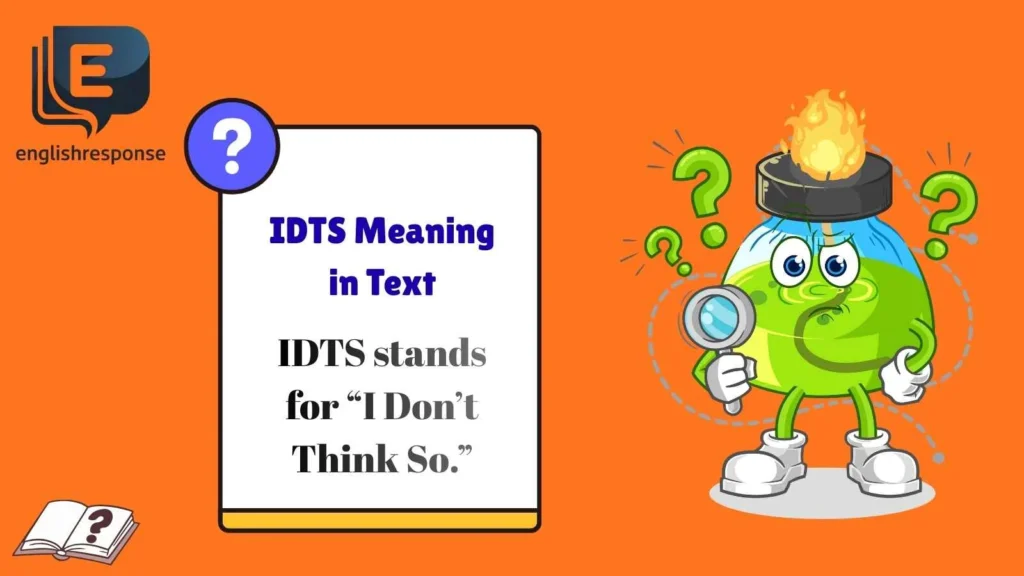
IDTS stands for “I Don’t Think So.”
Simple, right?
It’s commonly used in texting, social media, and casual chats when someone disagrees, doubts something, or gently says “no.”
But here’s the important part — the tone depends entirely on context.
For example:
- Friend: “Do you think he likes me?”
- You: “IDTS.”
In this case, it expresses doubt.
Another example:
- “Are you coming to the party tonight?”
- “IDTS, I have work early.”
Here, it’s more of a polite refusal.
It’s short, quick, and efficient — perfect for modern messaging where speed matters.
Origin and Background of the Term
Text abbreviations exploded in popularity in the early 2000s. With the rise of SMS texting and limited character counts, people began shortening phrases to save space.
Platforms like AOL Instant Messenger and later social media apps encouraged rapid, informal communication.
As texting evolved, phrases like “I don’t think so” were shortened into IDTS to make typing faster.
The acronym gained traction alongside other shorthand like:
- IDK (I don’t know)
- IMO (In my opinion)
- TBH (To be honest)
Today, IDTS is widely used across platforms like Instagram, TikTok, and messaging apps worldwide.
It’s a product of digital culture — fast, informal, and expressive.
How IDTS Is Used in Daily Life
You’ll typically see IDTS in casual, everyday conversations.
Here are common situations where people use it:
- Expressing doubt
- “Do you think it’ll rain today?”
- “IDTS, the sky looks clear.”
- Soft disagreement
- “That movie was amazing!”
- “IDTS, it was kinda boring.”
- Turning down invitations
- “Want to hang out tonight?”
- “IDTS, I’m tired.”
- Responding playfully
- “You’re the funniest person ever.”
- “IDTS 😂”
- Light sarcasm
- “You’re definitely going to wake up early tomorrow.”
- “IDTS.”
Notice how the meaning shifts slightly depending on tone. Sometimes it’s gentle. Sometimes it’s teasing.
That’s the beauty of modern texting language.
Emotional or Practical Meaning of IDTS
At its core, IDTS reflects uncertainty or disagreement.
But emotionally, it can mean more.
It can signal:
- Doubt
- Skepticism
- Playful sarcasm
- Polite refusal
- Defensive response
The tone depends on punctuation and context.
For example:
- “IDTS.” feels firm.
- “idts lol” feels softer.
- “IDTS 😂” feels playful.
In digital communication, tone is everything. Without facial expressions or voice cues, abbreviations like IDTS help communicate subtle feelings quickly.
Similar or Related Terms
Here are related texting abbreviations and how they differ:
- IDK – “I don’t know.” (Uncertainty)
- IMO – “In my opinion.” (Personal viewpoint)
- TBH – “To be honest.” (Honesty emphasis)
- SMH – “Shaking my head.” (Disapproval)
- Nah – Casual “no”
- Nope – Informal rejection
While IDTS expresses doubt or disagreement, IDK shows uncertainty. They’re close — but not the same.
Common Misunderstandings About IDTS
Let’s clear up a few myths.
1. It’s always rude.
Not true. Tone matters. It can be polite and casual.
2. It means “I don’t trust someone.”
Nope. That’s a completely different phrase.
3. It’s formal English.
Definitely not. It’s informal slang.
4. It’s only for teenagers.
Adults use it too, especially online.
5. It always means “no.”
Not exactly. Sometimes it expresses doubt rather than refusal.
Understanding context prevents awkward misunderstandings.
Examples of IDTS in Sentences
Here are natural, everyday examples:
- “IDTS that’s a good idea.”
- “You think they’ll cancel school?” — “IDTS.”
- “IDTS I can finish this tonight.”
- “He said he’s moving abroad.” — “IDTS, really?”
- “IDTS lol, that sounds fake.”
- “IDTS we’ve met before.”
- “IDTS she meant it that way.”
- “IDTS but let’s see what happens.”
See how flexible it is?
Why Understanding IDTS Meaning in Text Matters Today
Digital communication moves fast.
Misreading a short acronym can lead to confusion — or worse, conflict.
Understanding IDTS meaning in text helps you:
- Avoid misinterpretation
- Respond appropriately
- Stay socially aware
- Keep up with online language trends
In professional environments, you might avoid slang. But in casual spaces, knowing these terms makes you feel confident and connected.
Language constantly evolves. Staying informed keeps you relevant in conversations — whether on messaging apps, social media, or group chats.
And honestly, nobody wants to feel out of the loop.
FAQs:
What does IDTS mean in simple words?
It means “I don’t think so.” It’s used to show doubt or disagreement in texting.
Is IDTS positive or negative?
It depends on context. It can be neutral, playful, or slightly negative if expressing disagreement.
Where is IDTS commonly used?
It’s common in texting, social media, and online chats on platforms like Instagram and TikTok.
Is IDTS formal or informal?
It’s informal slang. Avoid using it in professional emails or formal writing.
Why do people search for IDTS meaning in text?
Because texting abbreviations can be confusing. People want clarity to avoid misunderstandings and respond correctly.
Change with passage of time — slang evolves, and new abbreviations appear constantly.
Conclusion:
So now you know.
IDTS meaning in text simply stands for “I don’t think so,” but its tone depends entirely on context. It can express doubt, disagreement, or playful sarcasm — all in just four letters.
Language is powerful. Even small abbreviations carry emotional weight in digital conversations.
By understanding modern slang, you’re not just learning vocabulary — you’re learning how people connect, joke, disagree, and communicate online.

Rana Sawalha is a passionate language enthusiast and author at EnglishResponse, dedicated to helping readers improve their English communication skills. With a focus on practical tips, engaging examples, and real-world conversation strategies, Rana Sawalha empowers learners to speak confidently and respond like a pro in any situation.