You’re scrolling through your messages, half awake, replying on autopilot, and suddenly someone drops “IMK” in a text. No emojis. No explanation. Just three letters staring back at you.
Your brain does that quick thing — Is that good? Bad? Am I supposed to reply?
You’re not alone. In today’s fast-moving digital world, text abbreviations change how we communicate, and missing their meaning can lead to awkward moments or misunderstood vibes. That’s exactly why understanding the IMK meaning in text matters more than you think.
At its core, IMK is simple, but its tone and intention can shift depending on context. It can sound polite, casual, or even distant if read the wrong way.
Knowing what it means — and how people actually use it — helps you communicate clearly, confidently, and without second-guessing yourself.
In this guide, we’ll break IMK down in plain English, explore where it comes from, how it’s used in real life, and why it still shows up in modern conversations.
What Does IMK Mean in Text?
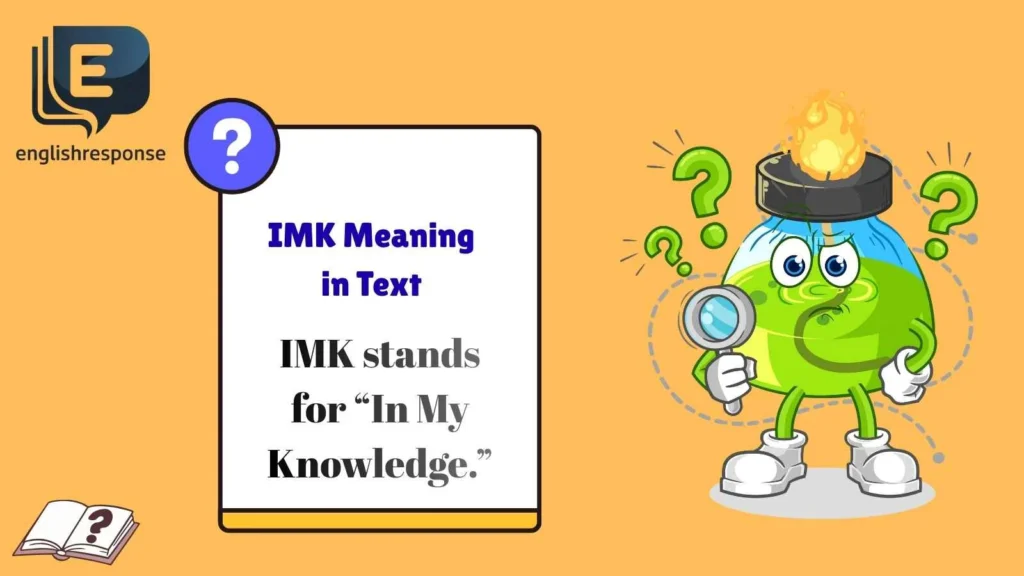
IMK most commonly stands for “In My Knowledge.”
People use it to share information based on what they personally know, without claiming absolute certainty. It’s a subtle way of saying, “This is true as far as I’m aware.”
Instead of sounding arrogant or overly confident, IMK keeps things humble and open-ended.
Real-life examples:
- “IMK, the store closes at 9 PM.”
- “IMK, she hasn’t replied to anyone yet.”
- “IMK, that update hasn’t rolled out everywhere.”
In simple terms, IMK signals personal understanding, not guaranteed facts.
Origin and Background of the Term
IMK didn’t explode overnight like viral slang. It grew quietly alongside early internet forums, emails, and chat rooms where people needed a quick way to express uncertainty without writing full sentences.
Back then, online discussions thrived on phrases like:
- “From what I know…”
- “As far as I’m aware…”
- “Based on my experience…”
Typing those repeatedly felt slow, so abbreviations like IMK naturally emerged. Over time, texting culture embraced it because it fit perfectly into casual, fast-paced conversations.
What’s interesting is that IMK reflects a deeper shift in communication — people became more careful about not overstating facts, especially online where misinformation spreads fast. IMK became a linguistic safety net.
How IMK Is Used in Daily Life
IMK shows up more often than you might realize. Here’s how people use it naturally:
- When answering a question without full certainty
- To avoid sounding bossy or absolute
- In group chats to keep discussions open
- During work conversations to stay professional
- In casual texts to soften statements
Examples in everyday situations:
- “IMK, the meeting got moved to Friday.”
- “IMK, he already submitted the form.”
- “IMK, that café is still closed.”
It’s short, polite, and socially safe.
Emotional or Practical Meaning of IMK
Beyond the literal meaning, IMK carries an emotional tone.
It quietly says:
- I’m being honest
- I’m not pretending to know everything
- Feel free to correct me
In a world where people often argue to be right, IMK feels refreshingly human. It shows humility and respect for others’ perspectives.
Practically, it helps prevent misunderstandings. Emotionally, it builds trust — especially in group chats, professional spaces, or sensitive conversations.
That’s why IMK continues to survive while other abbreviations fade out.
Similar or Related Terms
Here are some commonly confused or related expressions:
- AFAIK – As Far As I Know (very similar, more common)
- IMO – In My Opinion (subjective, not factual)
- FYI – For Your Information (informative, confident)
- TBH – To Be Honest (emotional honesty)
- IDK – I Don’t Know (no information at all)
IMK sits between certainty and uncertainty, which makes it uniquely useful.
Common Misunderstandings About IMK
Let’s clear up some confusion:
- IMK does NOT mean “I’m kidding”
- It’s not sarcasm by default
- It’s not rude or dismissive
- It doesn’t mean the information is false
- It’s not slang limited to teens
Most misunderstandings happen when people guess instead of asking. Once you know the meaning, it’s straightforward.
Examples of IMK in Sentences
Here’s how IMK sounds in real, natural conversations:
- “IMK, the deadline hasn’t changed.”
- “IMK, he’s still on vacation.”
- “IMK, that feature is only on Android.”
- “IMK, they already fixed the issue.”
- “IMK, the event starts at 6.”
- “IMK, she didn’t see the message yet.”
- “IMK, this works better on Wi-Fi.”
Notice how calm and non-aggressive it feels.
Why Understanding IMK Matters Today
Digital communication moves fast, but meaning still matters.
Misreading a small abbreviation like IMK can:
- Change the tone of a conversation
- Create unnecessary confusion
- Make you overthink simple messages
Understanding IMK helps you read between the lines, respond appropriately, and communicate like someone who’s digitally fluent.
In professional settings, it shows emotional intelligence. In personal chats, it prevents awkward moments.
Sometimes, knowing a small thing makes a big difference.
FAQs:
What does IMK mean in simple words?
IMK means “In My Knowledge”, used to share information based on what someone personally knows.
Is IMK positive or negative?
It’s neutral and polite, not negative or sarcastic.
Where is IMK commonly used?
In texts, group chats, emails, and online discussions.
Is IMK formal or informal?
Mostly informal, but acceptable in semi-professional chats.
Why do people search for IMK meaning in text?
Because abbreviations evolve, and people want to avoid misunderstandings as language changes with time.
Conclusion:
Language keeps evolving, but the goal stays the same — to be understood. The IMK meaning in text may seem small, but it carries honesty, humility, and clarity all at once.
Once you understand it, you stop guessing, stop overthinking, and start replying with confidence. And that’s powerful.
Remember, mastering modern communication isn’t about knowing everything — it’s about knowing enough to connect better. Keep learning, keep asking, and don’t let three little letters slow you down.

Rana Sawalha is a passionate language enthusiast and author at EnglishResponse, dedicated to helping readers improve their English communication skills. With a focus on practical tips, engaging examples, and real-world conversation strategies, Rana Sawalha empowers learners to speak confidently and respond like a pro in any situation.