You’re scrolling through your messages, half-awake, coffee in hand, when someone texts: “ISTG, that just happened.”
You pause. You’ve seen it before… but what does it actually mean?
Welcome to the wonderfully confusing world of internet slang. The phrase istg meaning in text has become incredibly common, especially in casual chats, social media comments, and late-night rants between friends. Yet a lot of people still guess its meaning from context rather than truly understanding it.
In simple terms, ISTG is a way people add emotion, intensity, and honesty to what they’re saying. It’s not just slang—it’s a reflection of how modern communication works: fast, expressive, and personal.
Understanding this term helps you read messages more accurately, avoid awkward misunderstandings, and even sound more natural when texting yourself.
What Does ISTG Mean in Text?
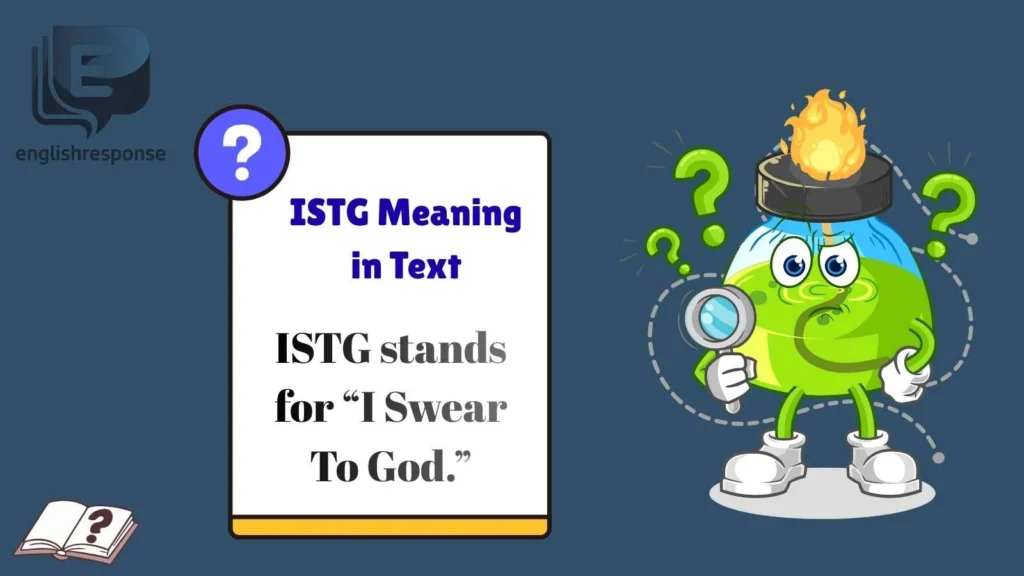
ISTG stands for “I Swear To God.”
But in texting, it’s rarely used in a religious sense. Instead, it’s more about emphasis and emotion. People use it to show they’re serious, frustrated, shocked, or completely honest.
- “I’m not joking”
- “Believe me”
- “I’m being 100% real right now”
Real-life examples:
- “ISTG, this traffic gets worse every day.”
- “ISTG, if my phone dies one more time…”
- “ISTG, that was the best pizza I’ve ever had.”
In each case, ISTG adds feeling. Without it, the sentence feels flat. With it, you hear the emotion loud and clear.
Origin and Background of the Term
Long before ISTG showed up in texts and DMs, people were already saying “I swear to God” out loud.
Historically, this phrase was used to:
- Make a promise
- Prove honesty
- Emphasize truth
Over time, language evolved. As texting became faster and character limits mattered, people shortened phrases. “Oh my God” became OMG. “I swear to God” naturally turned into ISTG.
What’s interesting is how the phrase shifted in meaning. Today, most users don’t think about God or religion at all when typing ISTG. It’s become a cultural expression—more emotional than literal.
This evolution shows how language adapts to technology and social habits. Slang isn’t lazy; it’s efficient storytelling.
How ISTG Is Used in Daily Life
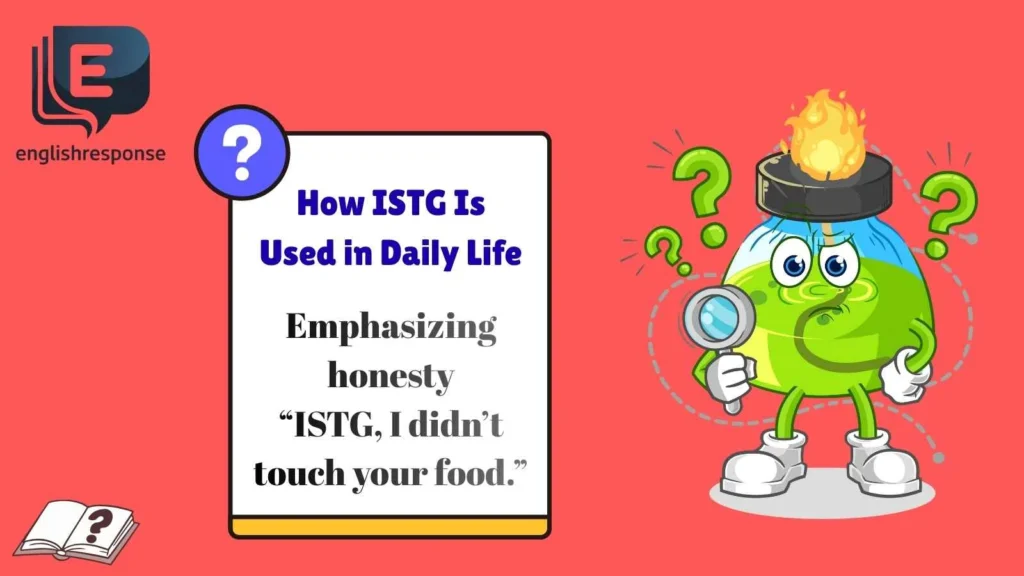
ISTG pops up everywhere, especially in casual digital spaces. Here’s how people actually use it day to day:
- Expressing frustration
“ISTG, this app crashes every time I open it.” - Emphasizing honesty
“ISTG, I didn’t touch your food.” - Reacting to something shocking
“ISTG, that plot twist ruined me.” - Making a playful threat or warning
“ISTG, if you’re late again…” - Sharing excitement
“ISTG, this song is stuck in my head.” - Adding drama for humor
“ISTG, my alarm hates me.”
Short, emotional, and straight to the point—that’s why people love it.
Emotional or Practical Meaning of ISTG
At its core, ISTG is about emotional clarity.
Texting removes tone of voice, facial expressions, and body language. ISTG fills that gap. It tells the reader, “Hey, this matters to me.”
Emotionally, it can signal:
- Frustration
- Sincerity
- Passion
- Urgency
Practically, it helps avoid confusion. Saying “I didn’t do it” feels weaker than “ISTG, I didn’t do it.” One sounds defensive. The other sounds genuine.
In modern culture, where conversations move fast, ISTG acts like an emotional highlighter.
Similar or Related Terms
Here are some terms that feel similar but aren’t exactly the same:
- OMG – Expresses surprise or shock, not honesty
- FR (For Real) – Confirms truth, more casual
- No cap – Means “no lie,” often playful
- TBH (To Be Honest) – Signals sincerity, softer tone
- Swear – Shortened version, very informal
Each has its own flavor. ISTG is usually stronger and more emotional than most of these.
Common Misunderstandings About ISTG
Despite how common it is, ISTG is often misunderstood.
- “It’s always religious”
Not true. Most users don’t mean it literally. - “It’s aggressive”
It can be intense, but it’s often playful or dramatic. - “Only angry people use it”
Nope. Excitement and humor count too. - “It’s rude or disrespectful”
Context matters. Among friends, it’s normal. - “It means someone is lying”
Actually, it’s usually used to stress honesty.
Understanding context is everything.
Examples of ISTG in Sentences
Here are some natural, everyday examples you might hear or read:
- “ISTG, my Wi-Fi stops working at the worst times.”
- “ISTG, I’ve watched that video ten times already.”
- “ISTG, you’re going to love this place.”
- “ISTG, I locked the door before leaving.”
- “ISTG, Mondays should be illegal.”
- “ISTG, that dog just smiled at me.”
- “ISTG, I can’t stop laughing.”
Each one sounds human, emotional, and real.
Why Understanding ISTG Matters Today
Language shapes connection. In a world where most conversations happen through screens, understanding slang like ISTG helps you read between the lines.
It matters because:
- You avoid misreading tone
- You communicate more naturally
- You connect better with younger generations
- You stay culturally relevant
Whether you’re a parent, student, professional, or content creator, knowing modern expressions helps you stay in sync with how people actually talk.
Slang isn’t about being trendy—it’s about being understood.
FAQs:
What does ISTG mean in simple words?
It means “I swear to God”, used to show honesty or strong emotion in a message.
Is ISTG positive or negative?
It can be both, depending on context. It might show excitement, frustration, or sincerity.
Where is ISTG commonly used?
Mostly in texts, social media, chats, and casual online conversations.
Is ISTG formal or informal?
It’s very informal and best used with friends or casual audiences.
Why do people search for ISTG meaning in text?
Because language changes with passage of time, and people want to understand modern communication without feeling out of the loop.
Conclusion:
So, the next time you see ISTG Meaning in Text is a message, you won’t hesitate or guess. You’ll understand the emotion behind the words, not just the letters on the screen.
Language is alive. It evolves with us, reflects our feelings, and helps us connect—even in tiny abbreviations.
Learning these small details keeps you confident, informed, and in tune with the world around you.

Rana Sawalha is a passionate language enthusiast and author at EnglishResponse, dedicated to helping readers improve their English communication skills. With a focus on practical tips, engaging examples, and real-world conversation strategies, Rana Sawalha empowers learners to speak confidently and respond like a pro in any situation.