Have you ever sent a long message, poured your thoughts into it, and received a short reply like “mk”?
If yes, you’re not alone — and you probably paused for a second, wondering what exactly does that mean?
In today’s fast-moving digital world, text conversations are full of shortcuts. Some feel friendly, some feel confusing, and some… feel a little cold. MK is one of those replies that can mean different things depending on context, tone, and even the relationship between the people texting.
At its simplest, mk meaning in text is a shortened response, but emotionally, it can carry more weight than it seems. A single two-letter reply can signal agreement, indifference, politeness, or even subtle annoyance.
Understanding what mk really means helps you read conversations better, avoid misunderstandings, and respond more confidently.
Whether you’re texting friends, coworkers, or someone you care about, knowing how to interpret mk can save you from overthinking — or under-thinking — a message.
What Does MK Mean in Text?
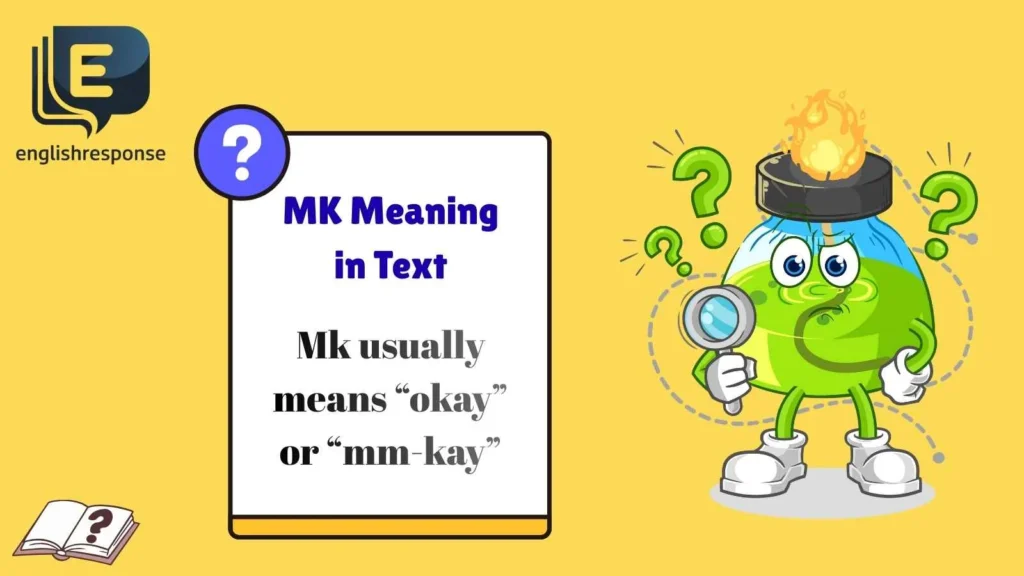
In text messaging, mk usually means “okay” or “mm-kay” — a casual acknowledgment that someone has read and accepted what was said.
It’s not enthusiastic, but it’s not aggressive either. Think of it as a neutral nod in conversation.
Here’s how it often works in real life:
- You: “I’ll be there around 7.”
- Them: “mk”
That reply means “Okay, I got it.”
Another example:
- You: “Don’t forget to send the file.”
- Them: “mk”
This signals understanding, not excitement.
And sometimes:
- You: “We need to talk later.”
- Them: “mk”
Here, the meaning can feel more emotionally loaded — neutral on the surface, but possibly distant underneath.
Context always matters with mk.
Origin and Background of the Term
The term mk didn’t come from grammar books or formal language. It grew naturally from spoken language and internet culture.
People have been saying “mm-kay” out loud for decades as a softer, sometimes passive way of saying okay. Over time, texting shortened everything — okay became ok, then k, and eventually mk.
The rise of instant messaging, chat apps, and social media pushed people toward speed over detail. Typing two letters felt easier than explaining tone.
Interestingly, mk also reflects how modern communication has shifted emotionally. We now rely on tiny signals — emojis, abbreviations, punctuation — to interpret feelings. MK became one of those subtle digital signals that carries meaning beyond its letters.
How MK Is Used in Daily Life

You’ll see mk everywhere once you start noticing it. Here are some common everyday uses:
- Acknowledging instructions
“Be ready by 8.”
“mk” - Ending a conversation quickly
“I’ll text you later.”
“mk” - Neutral agreement
“Let’s do it tomorrow.”
“mk” - Low-energy response
When someone doesn’t want to continue talking. - Work or group chats
Used to confirm without extra commentary. - Casual friendships
Where long explanations aren’t needed.
It’s short, efficient, and emotionally minimal — which is exactly why it can sometimes feel confusing.
Emotional or Practical Meaning of MK
Emotionally, mk sits in the middle ground.
It’s not warm like “sure!”
It’s not cold like “whatever.”
Instead, it’s emotionally neutral — but humans are emotional readers. We instinctively search for tone, even when there isn’t much.
In some cultures or personalities, mk is purely practical. In others, it can feel dismissive. That’s why reactions vary so much.
Socially, mk reflects modern communication habits:
- Short attention spans
- Multitasking
- Quick acknowledgments
- Minimal emotional investment
Understanding this helps you avoid assuming the worst when you see it.
Similar or Related Terms
Here are some terms often confused with mk, along with clear differences:
- OK – Neutral, standard agreement
- K – Very brief, can feel colder than mk
- Alright – Slightly more engaged
- Sure – Polite and agreeable
- Got it – Clear understanding, more professional
- Mm-hmm – Casual spoken equivalent
MK sits between ok and k in tone.
Common Misunderstandings About MK
Let’s clear up some common myths:
- “MK always means annoyance”
Not true. Often, it’s just quick acknowledgment. - “MK is rude”
It can feel rude, but intention depends on the sender. - “MK means the person is upset”
Sometimes yes, often no. - “MK ends the conversation forever”
Usually, it just pauses it. - “MK is lazy texting”
It’s efficient, not necessarily lazy. - “MK has one fixed meaning”
Context decides everything.
Examples of MK in Sentences
Here are some natural, everyday examples:
- “I’ll pick you up after work.” — “mk”
- “Please submit the report by Friday.” — “mk”
- “We’ll talk later, okay?” — “mk”
- “Don’t forget your charger.” — “mk”
- “Let’s meet at the café.” — “mk”
- “I’ll call you when I’m free.” — “mk”
- “Just letting you know.” — “mk”
Notice how neutral it sounds in most cases.
Why Understanding MK Matters Today
Modern communication is fast, digital, and emotionally compressed. We don’t always have tone of voice, facial expressions, or body language — just words on a screen.
Understanding terms like mk helps you:
- Avoid unnecessary overthinking
- Communicate more clearly
- Respond appropriately
- Read emotional context better
- Improve relationships, personal and professional
In a world where two letters can change how a message feels, awareness is power.
FAQs:
What does mk mean in simple words?
It simply means okay or I understand in a short, casual way.
Is mk positive or negative?
It’s usually neutral, but context can make it feel positive or distant.
Where is mk commonly used?
In texting, social media chats, group messages, and casual conversations.
Is mk formal or informal?
Informal. It’s not suitable for professional emails.
Why do people search for mk meaning in text?
Because tone is unclear, and people want to understand the emotional intent behind it — which changes with time and communication styles.
Conclusion:
At first glance, mk looks simple — just two letters. But like many things in digital communication, it carries more meaning than it seems.
Understanding the mk meaning in text helps you stop guessing, stop stressing, and start communicating with clarity. Not every short reply is negative, and not every neutral response deserves overthinking.

Rana Sawalha is a passionate language enthusiast and author at EnglishResponse, dedicated to helping readers improve their English communication skills. With a focus on practical tips, engaging examples, and real-world conversation strategies, Rana Sawalha empowers learners to speak confidently and respond like a pro in any situation.