Have you ever received a message that said, “You can opt in anytime” or “I’ll opt out,” and paused for a second?
You’re not alone.
The phrase opt meaning in text often confuses people because it sounds simple — but its usage can change depending on context. In everyday messages, emails, and online forms, “opt” quietly plays a powerful role in decision-making.
At its core, “opt” simply means to choose. But in texting and digital communication, it carries deeper practical and emotional significance. It represents control, preference, and personal choice.
Understanding this small word can help you avoid misunderstandings, respond correctly, and communicate more clearly in today’s digital world.
What Does OPT Meaning in Text?
In text messages or online communication, “opt” means to choose or select something intentionally.
It usually appears in phrases like:
- Opt in
- Opt out
- Opt for
Here’s how it works in real life:
- “You can opt in to receive updates.” → You can choose to receive updates.
- “She opted out of the group.” → She chose to leave.
- “I’ll opt for the cheaper plan.” → I choose the cheaper plan.
It’s not trendy internet language. It’s simply a more formal way of saying “choose.”
But why don’t people just say “choose”? Good question. We’ll get there.
Origin and Background of the Term
The word “opt” comes from the Latin word optare, which means “to choose” or “to wish.”
Over time, it entered English usage in the 19th century. But interestingly, it didn’t become popular in everyday communication until the digital age.
Why?
Because online systems needed a clear word for user permission. Companies needed users to actively choose whether they wanted emails, notifications, or subscriptions. So phrases like:
- “Opt in to our newsletter”
- “Opt out of marketing emails”
became standard.
What started as a formal term slowly became part of daily texting and online communication.
Now, it’s everywhere — from banking apps to WhatsApp group messages.
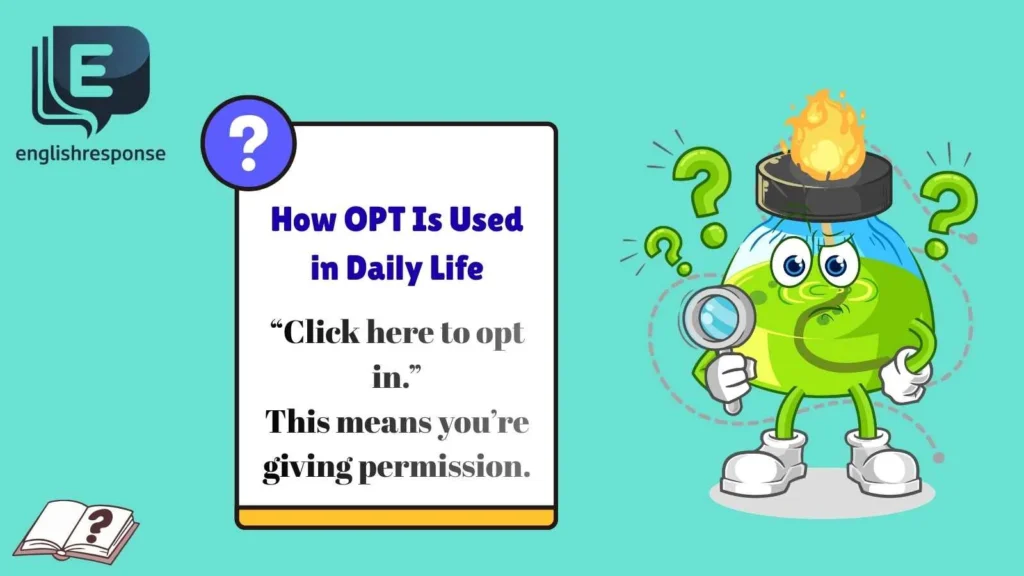
How OPT Is Used in Daily Life
You probably see “opt” more often than you realize.
Here are some practical, everyday uses:
- Email subscriptions
“Click here to opt in.”
This means you’re giving permission. - Unsubscribing from emails
“Opt out anytime.”
You can stop receiving messages. - Choosing a service plan
“I opted for the premium version.”
You selected the upgraded option. - Group chats
“He opted out of the discussion.”
He chose not to participate. - School or work forms
“Students may opt for online classes.”
They can choose online classes. - Apps and notifications
“Users must opt in for location access.”
You must agree to share your location.
Notice something? The word often appears when choice and permission are involved.
Emotional or Practical Meaning of OPT
Beyond definition, “opt” represents something important — control.
When someone says, “You can opt out,” it means:
You’re not forced.
You have a choice.
Your decision matters.
In today’s digital world, where we’re constantly asked to agree to terms, cookies, notifications, and subscriptions, the ability to opt in or out protects personal freedom.
It may seem like a small word, but it symbolizes empowerment and consent.
That’s why it’s so commonly used in privacy policies and online agreements.
Similar or Related Terms

Here are some related words and how they differ:
- Choose – The most general and common term.
- Select – Slightly more formal, often used in forms.
- Pick – Informal and casual.
- Decide – Focuses more on making a final choice.
- Elect – Often used in formal or voting contexts.
- Subscribe – Specifically means signing up for something.
The key difference?
“Opt” usually appears in situations involving permission or formal selection, especially in digital environments.
Common Misunderstandings About OPT
Let’s clear up a few common myths.
1. OPT is internet slang.
No, it’s a proper English word with Latin roots.
2. OPT always means something technical.
Not necessarily. It simply means to choose.
3. Opt in and opt out mean the same thing.
They’re opposites.
Opt in = join.
Opt out = leave.
4. It’s only used in emails.
Wrong. It’s used in schools, workplaces, apps, and daily conversation.
5. It sounds too formal for texting.
Actually, it’s very common in modern texting, especially in professional chats.
Examples of OPT in Sentences
Here are some natural, everyday examples:
- “I decided to opt for the annual subscription.”
- “You can opt out if you’re not interested.”
- “She opted in to receive SMS alerts.”
- “I might opt for coffee instead of tea.”
- “Students can opt out of the field trip.”
- “He opted to stay silent during the meeting.”
- “You must opt in before accessing premium features.”
- “They opted for a simpler solution.”
See how flexible it is?
Why Understanding OPT Meaning in Text Matters Today
In today’s world, communication is fast. Decisions are digital. And consent is critical.
Understanding opt meaning in text helps you:
- Avoid confusion in online forms
- Make informed subscription decisions
- Protect your digital privacy
- Communicate clearly in professional settings
- Respond correctly in conversations
Imagine misunderstanding “opt out” in a work email. That small confusion could cause embarrassment.
Clarity builds confidence.
And confidence improves communication.
FAQs:
What does opt meaning in text in simple words?
It simply means to choose. When someone says “opt in” or “opt out,” they’re talking about making a decision.
Is opt positive or negative?
It’s neutral. The meaning depends on context. “Opt in” can be positive. “Opt out” can also be positive if someone wants to leave something.
Where is opt commonly used?
It’s commonly used in emails, apps, online forms, workplaces, schools, and digital platforms.
Is opt formal or informal?
It’s slightly formal but widely accepted in everyday communication — especially online.
Why do people search for opt meaning in text?
Because phrases like “opt in” and “opt out” appear frequently in digital communication, and many people want clarity about what they truly mean.
Conclusion:
At first glance, “opt” seems like just another ordinary word.
But once you understand it, you realize it represents something powerful — choice, control, and consent.
In texting and digital communication, knowing the opt meaning in text helps you respond smarter, decide confidently, and communicate clearly.
Language shapes our understanding of the world. And even small words can carry big meaning.

Rana Sawalha is a passionate language enthusiast and author at EnglishResponse, dedicated to helping readers improve their English communication skills. With a focus on practical tips, engaging examples, and real-world conversation strategies, Rana Sawalha empowers learners to speak confidently and respond like a pro in any situation.